Showing posts with label transitional primary. Show all posts

Tuesday, October 18, 2016

TP IS WIRED


To conclude our unit on LINE and COLOR students examine the sculptures by American artist Alexander Calder.  We discussed how he manipulates wire to create a  variety of lines such as SPIRAL, WAVY, CURLY, and LOOPED.  Students learned how Calder used inspiration from the Ringling Brothers Circus to make his wire sculptures.  Next, we brainstormed all the different ways we can manipulate wire and came up with bending, twisting, zig zagging, curling, connecting, and curving.  Based on these techniques, students created their own wire sculptures paying careful to the principle of design BALANCE and element of design FORM.  For the previous class we defined PAINTING FROM OBSERVATION as painting what you see in front of you.  All of our young artists carefully observed the lines and colors in their sculptures and transferred it to their large scale
paintings only using the primary colors plus black and white. We had fun at the end of class trying to match each sculpture to its correct observational painting.  


Haring in The House Again!


This is the second time I have used Keith Haring and the other project I did with kindergarten can be found HERE. For this project, transitional primary studied mural artist Keith Haring and made these large scale paintings in response to his work.  First, we learned how during Haring's childhood, he loved to watch his dad draw cartoons.  Once he got older, he moved to New York City to study art, and started showing up in subway stations drawing cartoon like characters on the empty
advertisement black boards.


Image result for keith haring
Keith Haring

Image result for keith haring

Keith Haring

We discussed why someone would want to make art outside or in public areas versus for a Museum.  Students concluded that it cost money to go to a Museum and art that was public could be  enjoyed by EVERYONE, rich or poor. Additionally, we dissected the message behind many of his murals to be world peace and for people to love everyone regardless of their differences.

To create our own Haring inspired art, we first played freeze dance and for each time we stopped the music, our students would come up with a pose and then have their body traced.  For the next class, we practiced using the primary colors to paint secondary colors inside of our bodies.  After our bodies were filled with primary and secondary hues, we added white to create tints.  The last day was spent creating a variety of lines in our bodies from spiral, curvy, wavy and loopy to zigzag and pointed.  This project wraps up our unit on line and color.


Monday, November 30, 2015

Hokusai Fish Print Seascapes


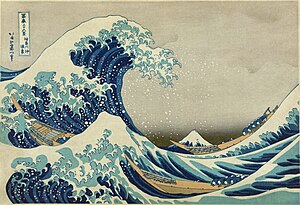
Transitional Primary students pretended to travel across the globe to Japan to examine artist and print maker Hokusai famous for his artwork titled The Great Wave off Kanagawa.  We discussed the reoccurring theme of NATURE in his art and discussed how the important role fish played in Japanese culture.  Students learned about the tradition of Japanese fish printing called GYOTAKU and discussed how fisherman used this style of artmaking to keep track of the fish they caught.  We tried our own Gyotaku's, by printing on rubber fish.  Next, we learned how a seascape is a view of the sea and created our own, with oil pastel resist with watercolor.  Finally, our best prints were cut out and creatively incorporated into our seascapes.

Great Wave off Kanagawa2.jpg
The Great Wave Off of Kanagawa, Katsushika Hokusai 1830-1833


Student Work


Monday, October 27, 2014

Pollock Inspired Murals

Our Transitional Primary students have been learning all about LINES.  They started the year off by representing horizontal, vertical, and diagonal lines with tape.  On day one, they have started to  notice a variety of lines in some of artist Jackson Pollock's work, and described them as curvy, dotted, zig zag, wavy, jagged, and spiral. We also discussed how Pollock used his whole body to paint and how he used lines and colors to express how he felt.  Many of Pollock's paintings were  so enormous, he had to lay them on the floor to work on it and often painted from all four sides of his canvas.  Similarly, we worked large for this painting, as well as collaboratively, from all different spots around the table.  Students had to touch the side of the paper or connect their line to another one they saw.  To reinforce and build on our knowledge of lines, we finished off the class reading Lines That Wiggle, by Candice Whitman.  


Echo: Number 25, Jackson Pollock

Jackson Pollock in action.


The She Wolf, 1943  Jackson Pollock


Student Murals Inspired by Jackson Pollock and Abstract Art


On day two, we learned how primary colors are the only colors on the color wheel that cannot be made by mixing any two colors together.  We filled in the shapes of this mural by mixing the primary colors red, blue, and yellow to make secondary colors.  Additionally, we learned how ABSTRACT ART is when artists purposely use their imagination to create an artwork that does not look real and REALISTIC ART, is when artists create art to look like a photograph or something recognizable.  we examined The She-Wolf, by Jackson Pollock and categorized him as an ABSTRACT PAINTER, as well as our own murals as an abstract piece of art.  

Thursday, August 7, 2014

Roaring Recycled Jungle Animals


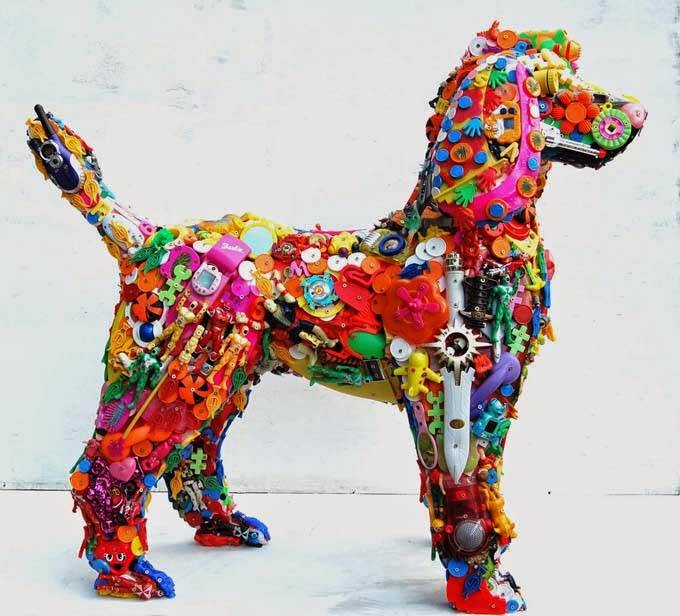
This unit focuses on the use of RECYCLED GOODS to make art.  First, we examined the work of Robert Bradford, and when students looked really closely they were able to see TOYS were the main material used in his work.  After some discussion, most students agreed these toys were not bought to make the animal sculptures but probably were found or collected or a period of time.  We started to brainstorm what we could define as TRADITIONAL ART MATERIALS (most commonly used) vs. NON-TRADITIONAL ART MATERIALS (not used often).  Some traditional materials would include paint, pencils, and oil pastels while non traditional materials could include tape, discarded/found objects such as boxes, cardboard, newspaper or a single mass produced item such as toys, shoes etc.  Below were different artists we referenced.  


Artist Examples


Robert Bradford, The Cool Hunter, Toys on Wood


Dean Patman


Will Kurtz

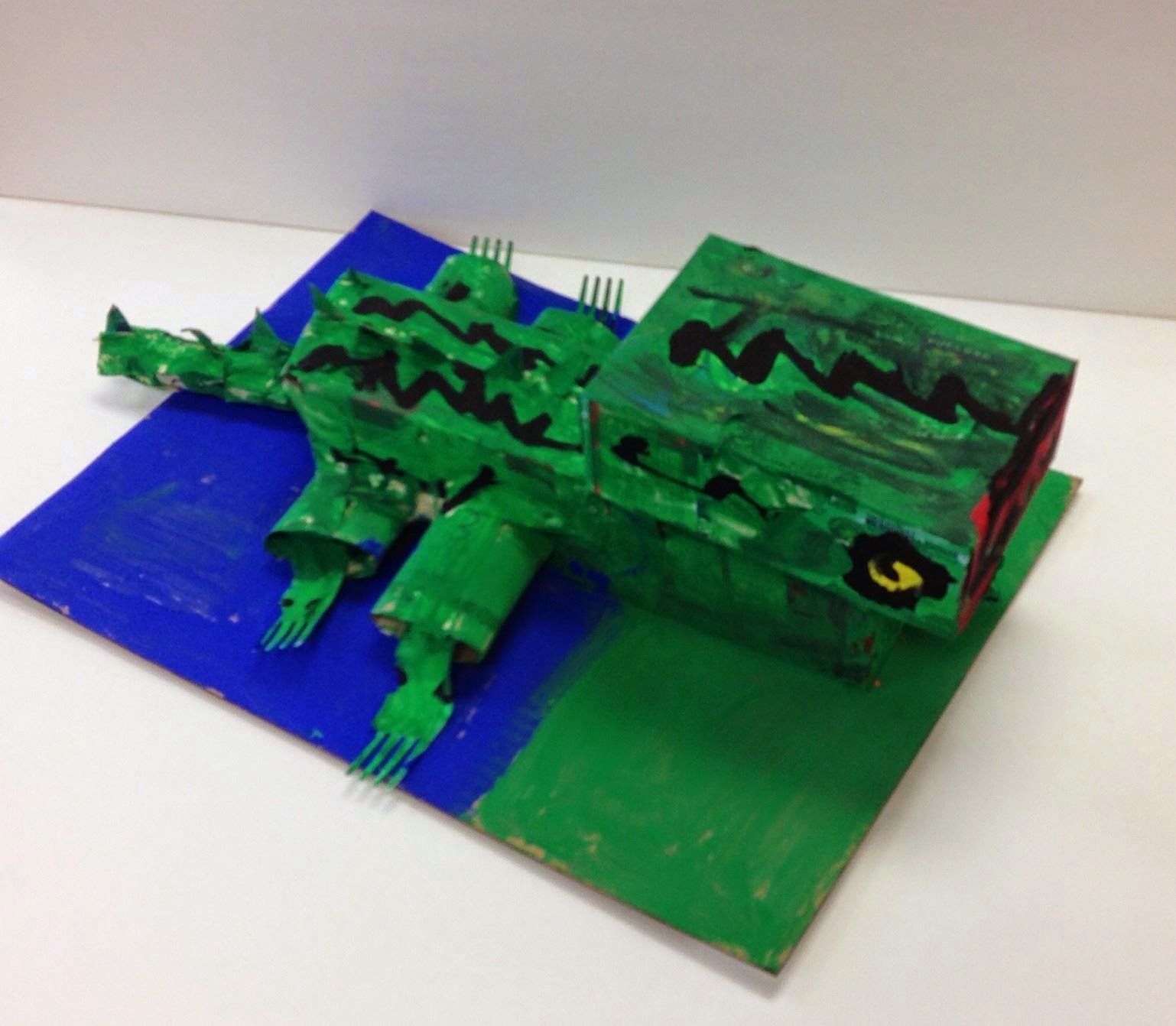
To start our own artwork from non traditional art materials, students had a variety of recycled materials such as different size boxes, toilet paper roles, wine corks, bottle caps, and some plastic utensils.  Students were shown how by combining a variety of shaped boxes and properly attaching them with masking tape, (making sure to run their finger across the whole piece of tape to stay down) they could form the basic shape of an animal.  We were limited to choosing jungle animals  and were able to use the smaller recycled objects to add details.  Some strategies by our young artists were using a part of a fork for alligator feet, cut toilet paper rolls for the main of a lion, the top of a knife, and bottle caps or corks for eyes.  Students were able to help each other when attaching tape and making a sturdy animal that could stand up on its own.  The last step was painting their jungle animal friends! 

Students in Progress


Student Examples